Indus at a Glance: A Railway-Origin Community on Calgary's Eastern Fringe
Indus is officially categorized as a hamlet in the Canadian Geographical Names Database, and Rocky View County identifies it as one of its communities. The locality began as a railway and agricultural settlement after the Canadian Pacific Railway reached the district. One documented account states that Dr. J.M. Fulton proposed the name Indus in 1914 as a shortened form of "industry," reflecting an expectation that industrial growth would spread eastward from Calgary. The anticipated industrial town never fully materialized, but the railway corridor — now operated by Canadian Pacific Kansas City — remains active through the area.
Housing Stock and Property Patterns
The 2021 census recorded 15 private dwellings in the Indus designated place, all occupied. The Area Structure Plan describes the settlement as a compact railway-origin community with a small number of residences, institutional and recreation facilities, and former grain-handling sites. The residential character is dominated by single-detached rural houses on large parcels, with farm residences and acreages in the surrounding country.
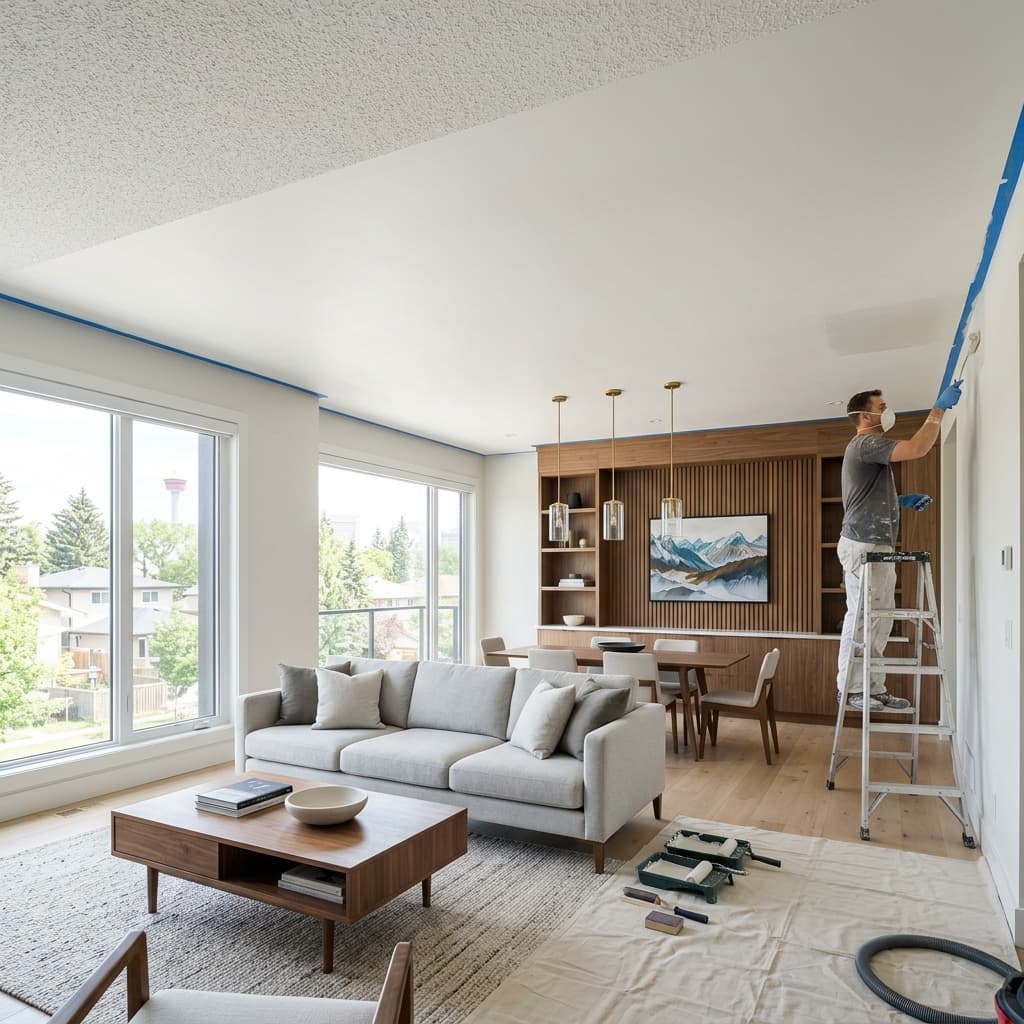
Because the community has not experienced dense suburban expansion, much of the housing stock reflects an established rural context. That pattern has practical implications for interior work: repainting a home in an established rural house often begins with surface inspection, minor drywall or plaster correction, sanding with dust control, and careful priming — especially where previous coatings have aged. A site review is the appropriate starting point before any repainting or surface renewal begins.
A Rural Economy Anchored by Agriculture and Local Institutions
Indus's economy is grounded in agriculture, ranching, equestrian activity, education, recreation and construction, with many residents commuting to Calgary, Chestermere, Langdon and Strathmore for employment. Field-crop production, grain storage, livestock operations and agricultural services remain important across the surrounding district. The Indus Recreation Centre, including the Bill Herron Arena, is a regional destination for hockey, ringette, figure skating, lacrosse, baseball and equestrian events.
Two significant planning developments sit just beyond the small designated-place boundary. Rocky View County approved the Beacon AI Hub Area Structure Plan on June 17, 2025, covering approximately 900 acres near Indus for a proposed data-centre campus, and the county documents Fulton Industrial Park, a 523-acre master-planned heavy-industrial development immediately north of Highway 22X near Indus. In addition, the county has advanced planning for a proposed expansion of the Indus Recreation Centre, including a CAD 12 million capital-budget request for an additional ice sheet.
Climate and Environmental Factors
The Indus area experiences a Southern Alberta prairie climate with several conditions relevant to exterior coatings. The data identifies the following regional factors:
- Frequent seasonal freeze-thaw cycles
- Documented exposure to hail-producing thunderstorms
- Strong winds and chinook-related temperature changes
- Blowing and drifting snow across open agricultural terrain
- Regional wildfire smoke affecting local air quality
- Periodic drought and soil-moisture deficits
These conditions do not mean every property needs immediate repainting, but they do mean exterior surfaces — siding, stucco, masonry, trim, fascia and wood features — benefit from regular inspection and coating systems selected for the regional environment.
How Indus's Local Conditions Relate to Painting Work
Exterior Painting: Preparation and Weather-Window Planning
In a climate with freeze-thaw cycles and hail events, the condition of a home's exterior coating system is a relevant factor to consider. Repeated freezing and thawing can stress aged coatings, and severe thunderstorms can leave exposed walls and trim with scuffed or damaged surfaces. The appropriate response is not simply another coat of paint: it is a careful inspection of the substrate, removal of loose or failing coating, washing where substrate-appropriate, and priming with a compatible system before finish coats are applied.
For properties near Highway 22X or Highway 791, exterior surfaces may also collect dust, road film or agricultural residue over time. Pressure washing and surface decontamination, where the substrate allows, can help create a clean base for recoating. Exterior work in Southern Alberta is also a matter of timing: temperature and weather windows matter for both drying and curing, which is why exterior painting in this region is planned around the season and the forecast.
Interior Work in Established Rural Homes
Established homes in the Indus area can present a range of interior painting needs: refresh a high-use kitchen or bathroom, renew trim and doors, update a finished basement, or repaint an entire main floor. In older houses, the quality of the underlying wall surface often determines how the finished paint will look. Drywall repair and surface preparation — patching, sanding with dust control, spot priming — are frequently the difference between a paint job that looks fresh and one that simply covers the old surface. Basement painting in particular benefits from a prior review of substrate and moisture conditions, especially given the area's flat terrain, snowmelt and localized overland drainage patterns.
Commercial, Institutional and Industrial Buildings
Indus's institutional buildings — the school, the recreation centre, the community hall and operating facilities — are maintained to serve a regional population far larger than the community's census count. For a facility such as the Indus Recreation Centre, high-ceiling spaces, hall interiors and arena-adjacent areas create painting scopes that need phased scheduling and durable, washable finishes. Retail, hospitality or office settings in nearby centres along Highway 22X face similar considerations around operational disruption and customer-facing presentation.
The Beacon AI Hub and Fulton Industrial Park developments near Indus also point to a wider regional context: large industrial buildings, data-centre structures and employment-oriented facilities require coating systems that can handle large-surface application, access planning and durable industrial finishes. While those projects are still in various stages of planning, their presence underscores how the broader Highway 22X employment corridor is reshaping the area around Indus from a purely agricultural landscape into a mixed rural-industrial region.
How Brixel Painting Approaches These Projects
Brixel Painting is a Calgary-based painting contractor whose process is built around preparation-first project scoping, itemized estimates and coating selection suited to Southern Alberta conditions. Before any paint is specified, the existing substrate is reviewed — whether that means checking adhesion on exterior siding, evaluating a masonry wall's breathability, or inspecting a basement wall for moisture signs. The company states that it is licensed, insured and WCB-covered, and its workmanship is backed by a two-year warranty.
For commercial or institutional projects, Brixel plans phasing to reduce operational disruption where the scope allows. For residential work, the emphasis is on protecting the property, controlling dust, and finishing with surfaces that are washable and durable. As with any project, the first step is a site review to confirm scope, access and coating options.
To discuss a painting project — whether it is a rural home, a recreation facility or a commercial building — contact Brixel Painting to request a free estimate and schedule a site review.
Nearby Communities and Rural Areas
Indus sits within a network of small communities and rural districts southeast of Calgary. These areas share similar property patterns and regional conditions.